The Assam VFA Syllabus 2026 is important for candidates preparing for the Veterinary Field Assistant (VFA) and allied cadre recruitment examination under the Directorate of Animal Husbandry and Veterinary, Assam. The written examination will consist of 100 multiple-choice questions carrying 100 marks, with a total duration of 2 hours. The prescribed examination standard is HSSLC (Science).
The written examination covers four major areas: Biology, Chemistry, Physics and General Awareness. Biology carries the highest weightage with 40 marks, while Chemistry, Physics and General Awareness carry 20 marks each.
Assam VFA Syllabus & Exam Pattern 2026
Assam VFA Syllabus includes the topics asked from Biology, Chemistry, Physics and General Awareness. Candidates should prepare for the Written Exam by referring to the Assam VFA Syllabus 2026 as mentioned in the article below.

Assam VFA Syllabus & Exam Pattern 2026-Overview
| Post Name | Veterinary Field Assistant |
| Organization | AH&V Department |
| Exam Type | Written Examination |
| Exam Mode | Offline (OMR) |
| Total Questions | 100 Questions |
| Full Marks | 100 Marks |
| Exam Duration | 2 Hours |
| Exam Standard | HSSLC (Science) |
The official information currently specifies the subjects and marks but does not provide a chapter-wise official syllabus, negative-marking rule or examination language.
Assam VFA Written Exam Pattern
The written exam will have 100 questions for a total of 100 marks. The prescribed standard is HSSLC (Science), or Class 12. The allotted 120 minutes applies to the complete written examination. The notices do not prescribe a separate time limit for each subject.
| Subject | Marks |
|---|---|
| Biology | 40 |
| Chemistry | 20 |
| Physics | 20 |
| General Awareness | 20 |
| Total | 100 |
Biology carries as many marks as Chemistry and Physics combined. It therefore deserves a larger share of revision time, although the other three subjects together still account for 60% of the paper. As of now, the chapter-wise allocation of marks within these subjects is not notified.
What Is the Standard of the VFA Examination?
The prescribed standard is HSSLC (Science), or Class 12. Class 9 and 10 science can help candidates revise the foundations, but preparation should also cover the relevant Class 11 and 12 concepts. Studying only lower-school general science would leave substantial parts of Physics, Chemistry and Biology uncovered.
The one-year training in Elementary Knowledge of Animal Husbandry and Veterinary Science is a separate requirement after selection. Selected candidates must complete and pass that training before appointment. It should not be confused with the written-test syllabus, which lists the four subjects shown above rather than a separate professional Veterinary Science paper.
Assam VFA Syllabus 2026
The most important part of exam preparation is the syllabus. It helps you know exactly what will be asked in the exam and helps you avoid unnecessary topics, saving time. When candidates cover all the topics in the syllabus, they feel confident, and they score good marks. Here is the list of all topics covered in the Assam VFA Syllabus 2026.
Biology – 40 Marks
Biology carries the highest weightage in the Assam VFA written examination. Candidates should focus on understanding biological structures, functions, processes and their relationships.
| Topic | Important Areas for Preparation |
|---|---|
| Living World & Classification | Characteristics of living organisms, scientific naming, classification, plant groups, animal phyla, vertebrate classes, bacteria, fungi, plants, animals and viruses |
| Cells, Tissues & Biomolecules | Prokaryotic/eukaryotic cells, plant and animal cells, organelles, diffusion, osmosis, active transport, tissues, carbohydrates, proteins, lipids, nucleic acids, enzymes, mitosis and meiosis |
| Plant Structure & Life Processes | Roots, stems, leaves, transport, transpiration, mineral nutrition, nitrogen fixation, photosynthesis, respiration, germination, tropic movements and plant growth regulators |
| Ecology & Environment | Ecosystems, habitats, food chains, food webs, energy flow, ecological pyramids, decomposition, nutrient cycles, biodiversity, conservation, pollution, greenhouse warming and ozone depletion |
| Nutrition, Breathing & Circulation | Digestion, absorption, assimilation, digestive organs and enzymes, breathing, gas exchange, blood, blood groups, heart, blood vessels and lymph |
| Excretion, Movement & Coordination | Kidneys, nephron, urine formation, bones, muscles, joints, neurons, brain, spinal cord, reflex action, eye, ear and endocrine glands |
| Reproduction | Sexual and asexual reproduction, vegetative propagation, flowers, pollination, fertilisation, seed formation, human reproduction, menstrual cycle, pregnancy and reproductive health |
| Heredity & Molecular Biology | Genes, alleles, chromosomes, genotype, phenotype, Mendel’s laws, monohybrid crosses, sex determination, sex-linked inheritance, DNA, RNA, replication, transcription and translation |
| Evolution & Adaptation | Variation, mutation, adaptation, natural selection, speciation, fossils, homologous and analogous organs and basic human evolution |
| Health, Disease & Immunity | Communicable/non-communicable diseases, pathogens, parasites, vectors, immunity, antibodies, vaccination, nutritional deficiencies, hygiene and public health |
| Microbes, Biotechnology & Animal Husbandry | Useful microbes, food production, antibiotics, sewage treatment, biogas, biofertilisers, recombinant DNA, PCR, dairy, poultry, fisheries, apiculture, breeding, feed and hygiene |
These areas are based on the detailed preparation outline in the supplied source; they are not presented as an official chapter-wise notification.
Chemistry – 20 Marks
Chemistry preparation should include physical, inorganic and organic chemistry. Candidates should practise formulas, chemical equations, functional groups and basic numerical problems.
| Topic | Important Areas for Preparation |
|---|---|
| Matter, Atoms & Periodic Table | Elements, compounds, mixtures, separation methods, atomic/mass numbers, ions, isotopes, electronic configuration, valency, mole, molar mass and periodic trends |
| Bonding, Reactions, Acids & Bases | Ionic/covalent bonding, electron-dot structures, molecular shapes, hydrogen bonding, chemical reactions, oxidation, reduction, acids, bases, indicators, pH and salts |
| Physical Chemistry | Gas laws, solutions, concentration, solubility, osmosis, colloids, thermochemistry, equilibrium, reaction rates, catalysts, electrolytes, cells, electrolysis, batteries and corrosion |
| Carbon & Organic Compounds | Hydrocarbons, homologous series, nomenclature, isomerism, alcohols, phenols, ethers, aldehydes, ketones, carboxylic acids, amines and basic organic reactions |
| Elements & Inorganic Compounds | Metals, non-metals, reactivity series, extraction, alloys, gases, salts, oxides, transition elements and coordination compounds |
| Chemistry in Everyday Life | Biomolecules, polymers, soaps, detergents, water hardness, fertilisers, fuels and household chemicals |
Physics – 20 Marks
Physics preparation should combine conceptual understanding with numerical practice. Candidates should learn the meaning and units of formulas and understand where each formula can be applied.
| Topic | Important Areas for Preparation |
|---|---|
| Measurement & Mechanics | SI units, conversions, measuring instruments, motion, velocity, acceleration, Newton’s laws, momentum, friction, work, energy, power, gravitation, circular motion and torque |
| Properties of Matter & Heat | Density, pressure, buoyancy, elasticity, viscosity, surface tension, heat, temperature, thermal expansion, specific heat, latent heat, conduction, convection and radiation |
| Oscillations, Waves & Sound | Time period, frequency, amplitude, wavelength, wave speed, transverse/longitudinal waves, pitch, loudness, echoes, resonance and ultrasound |
| Electricity & Magnetism | Charge, electric field, potential, capacitance, current, voltage, resistance, Ohm’s law, circuits, power, energy, magnetic fields, motors, induction, generators, transformers, AC/DC, fuses and earthing |
| Light & Optical Instruments | Reflection, refraction, mirrors, lenses, image formation, magnification, lens power, eye defects, dispersion, scattering, total internal reflection, microscopes and telescopes |
| Atomic, Nuclear & Electronic Physics | Electromagnetic spectrum, photons, photoelectric effect, atomic models, radiation, half-life, fission, fusion, semiconductors, diodes, rectifiers and solar cells |
General Awareness – 20 Marks
General Awareness can be divided into Assam-related knowledge, Indian/general knowledge and current affairs for preparation. The supplied source notes that the department has not separately allocated marks among these areas.
| Topic | Important Areas for Preparation |
|---|---|
| Assam Geography, Environment & Economy | Assam’s location, neighbouring areas, valleys, hills, climate, Brahmaputra and Barak, protected areas, wildlife, tea, petroleum, agriculture and silk |
| Assam History & Culture | Ahom and Koch history, Battle of Saraighat, Treaty of Yandabo, freedom movement, Sankardeva, Madhavdeva, literature, festivals, traditions and heritage |
| Indian History & Geography | Ancient, medieval and modern India, freedom struggle, physical geography, rivers, climate, soils, crops, resources, states and neighbouring countries |
| Constitution & Government | Preamble, Fundamental Rights, Fundamental Duties, Directive Principles, President, Governor, Parliament, state legislatures, judiciary, local government, elections and constitutional bodies |
| Economy, Institutions & GK | Economic sectors, money, banking, inflation, public finance, national/international institutions, computers, internet, digital safety, awards, sports and important days |
| Current Affairs | Assam and national developments, government initiatives, science, environment, sports, awards and important international events |
How to Prepare for the Assam VFA Exam?
Step 1: Use the topic outline to check your Class 11 and 12 science textbooks and identify the areas you have forgotten. Return to Class 9 and 10 material only where a missing foundation prevents you from understanding the higher-secondary topic.
Step 2: Keep revision notes suited to each subject: organ and function comparisons for Biology, formulas and reactions for Chemistry, formulas with units for Physics, and dated facts for General Awareness. Review the topics in which your practice answers are repeatedly wrong.
Step 3: Attempt a complete 100-question practice test within 120 minutes, including the time spent filling an OMR sheet. Separate mistakes caused by weak concepts, calculations, misreading, and answer-sheet marking so that the next revision session addresses the actual problem.
Step 4: Check the official website link in the Important Links section for examination instructions. Confirm the negative-marking rule, paper language, and examination schedule from the department before deciding your final test-taking approach.
Assam VFA Syllabus 2026 – Important Points
- The examination consists of 100 MCQs for 100 marks.
- Total examination duration is 2 hours.
- Biology carries 40 marks, the highest weightage.
- Chemistry, Physics and General Awareness carry 20 marks each.
- The prescribed standard is HSSLC (Science).
- The examination is specified as offline/OMR.
- The chapter-wise syllabus has not been officially notified in the supplied information.
- Negative marking and examination medium are to be notified.
- Candidates should practise complete papers within 120 minutes.
- The one-year Animal Husbandry and Veterinary Science training is separate from the written-test
Assam VFA Syllabus 2026 – Quick Table
| Subject | Marks | Priority |
|---|---|---|
| Biology | 40 | Highest |
| Chemistry | 20 | Important |
| Physics | 20 | Important |
| General Awareness | 20 | Important |
| Total | 100 | — |
Important Links of Assam VFA Syllabus
| VFA Exam Guide | Click Here |
| MCQs Parctice | Click Here |
| Official Recrutment Notification | Click Here |
| Follow Our Whatsapp Channel | Click Here |
| Follow our Telegram Channel | Click Here |
| Follow us on Twitter (X) | Click Here |
| Join Us on Linkedin | Click Here |
| More Job News | Click Here |
FAQs – Assam VFA Syllabus 2026
What is the Assam VFA exam pattern?
The written examination consists of 100 MCQs carrying 100 marks, with a duration of 2 hours. The examination is conducted in offline OMR mode.
How many marks are allotted to Biology?
Biology carries 40 marks, making it the highest-weighted subject in the written examination.
What are the subjects in the Assam VFA syllabus?
The written examination covers Biology, Chemistry, Physics and General Awareness.
What is the standard of the Assam VFA examination?
The prescribed standard is HSSLC (Science), or Class 12 level.
Is there negative marking in the Assam VFA exam?
The supplied recruitment information does not specify the negative-marking rule. Therefore, candidates should check the official examination instructions before the exam.
Is the chapter-wise Assam VFA syllabus officially available?
The supplied source states that the official notification does not provide a chapter-wise syllabus. The detailed topic list above is provided as study guidance and should not be treated as an exhaustive official syllabus.
How should candidates prepare for the Assam VFA exam?
Candidates should revise Class 11–12 Science, prepare subject-wise notes, practise 100-question mock tests within 120 minutes and regularly review their mistakes.
Conclusion
The Assam VFA Syllabus 2026 provides a clear four-subject structure for the written examination: Biology, Chemistry, Physics and General Awareness. With Biology carrying 40 marks and the remaining subjects carrying 20 marks each, candidates should build their preparation around the HSSLC Science standard while also giving sufficient attention to Assam-related General Awareness and current affairs.
Since the detailed chapter-wise syllabus, negative-marking rule and examination language are not yet specified in the supplied information, candidates should verify these details from the department’s official examination instructions before finalising their exam strategy.
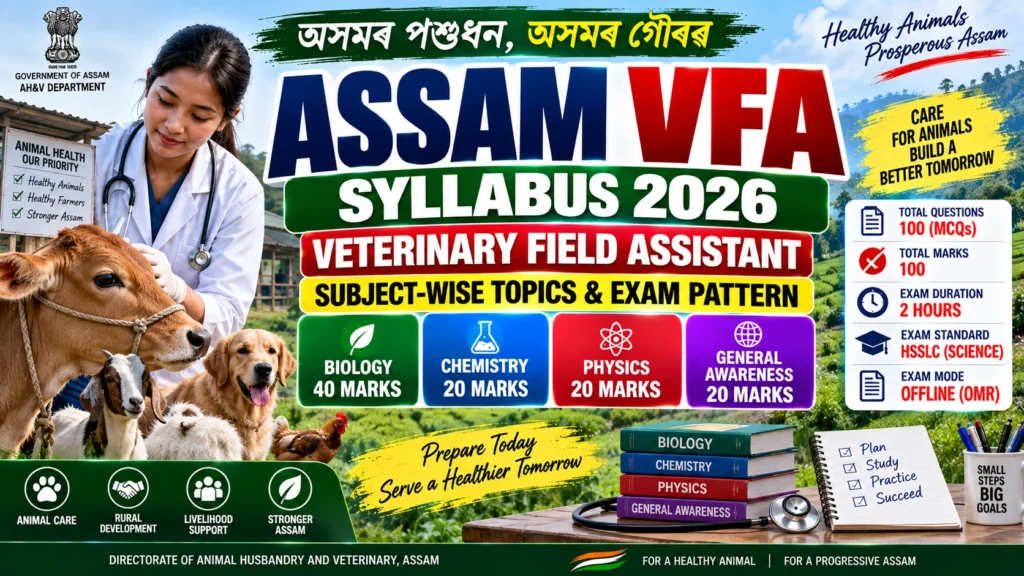 verified Official Banner
Check Your Eligibility With Free Age Calculator
Calculate your exact age as on advertisement cut-off date.