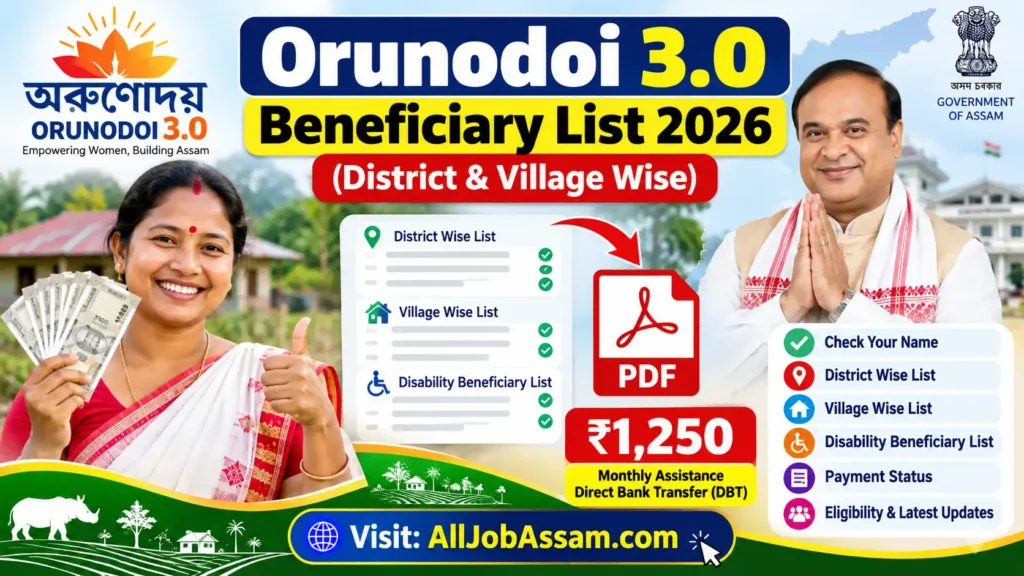
Orunodoi 3.0 Beneficiary List 2026
Check the latest Orunodoi 3.0 beneficiary list in Assam for 2026. Learn how to verify your name through your Gaon Panchayat, VCDC, municipal office or Block Development Office (BDO), understand the monthly financial assistance, check payment-related problems, and find out what to do if your name is missing from the approved list.
The Orunodoi 3.0 scheme is an important welfare initiative of the Government of Assam. It aims to provide financial support to eligible households through women beneficiaries. The scheme helps families manage essential household expenses and improve their financial security.
Many applicants are now searching online for the Orunodoi 3.0 Beneficiary List 2026, Assam Orunodoi New List, district-wise beneficiary records, village-wise lists and Orunodoi 3.0 PDF downloads. However, applicants should verify the availability of any list through an authorised government source instead of relying on unofficial download links.
This article explains the available verification methods, payment information, eligibility checks, disability-related enquiries and steps to take if your application has not been approved.
Orunodoi 3.0 Beneficiary List 2026: Overview
Here are the main details applicants should know before checking their beneficiary status.
| Particulars | Details |
|---|---|
| Scheme name | Orunodoi 3.0 Scheme |
| State | Assam |
| Implementing authority | Government of Assam |
| Main objective | Financial assistance to eligible households |
| Primary beneficiary | Eligible women beneficiaries |
| Monthly assistance | ₹1,250, subject to applicable scheme rules |
| Payment method | Direct Benefit Transfer (DBT) |
| Beneficiary verification | Authorised local government office or officially supported service |
| District-wise information | Check with the concerned district administration |
| Village-wise information | Contact the relevant Gaon Panchayat or VCDC |
| Urban beneficiary information | Contact the concerned municipal authority |
| Helpdesk | 1800-202-6256, as listed in the government notification |
| Official information | Assam Finance Department and district administration websites |
Important: The Assam Government announced the first Orunodoi 3.0 disbursement for the 2026–27 financial year on 1 August 2026. Official reporting stated that the programme covered more than 37 lakh women beneficiaries and provided ₹1,250 in monthly assistance. Individual eligibility, payment status and list availability must still be verified through authorised channels.
Latest Update on Orunodoi 3.0 in Assam
The Government of Assam introduced Orunodoi to provide financial assistance to economically vulnerable households, with women serving as the primary beneficiaries.
The Orunodoi 3.0 programme continues this objective through financial support delivered using the Direct Benefit Transfer system. Under DBT, eligible assistance is transferred electronically to the beneficiary’s designated bank account in accordance with the applicable payment arrangements.
On 1 August 2026, the Chief Minister launched the first disbursement of Orunodoi 3.0 for the 2026–27 financial year. The announcement covered more than 37 lakh women beneficiaries across Assam, with monthly assistance of ₹1,250.
The government has also highlighted Aadhaar-linked payment arrangements as part of efforts to reduce duplication and improve payment delivery.
However, the announcement of a payment round does not necessarily mean that every applicant has been approved or that every beneficiary will receive money on the same day. Payment processing, bank verification and individual records can affect when a particular beneficiary receives assistance.
Applicants should therefore check their own records rather than relying only on general announcements shared on social media.
How to Check the Orunodoi 3.0 Beneficiary List 2026
If you applied for Orunodoi 3.0 and want to know whether your name appears on the approved beneficiary list, follow the steps below.
Step 1: Visit Your Local Gaon Panchayat Office
For applicants living in rural areas, the Gaon Panchayat is an appropriate starting point for beneficiary-related enquiries.
Visit your local office and explain that you want to check your status in the Orunodoi 3.0 beneficiary list for 2026.
Ask the responsible official whether the approved list, application records or relevant verification details are available for your village.
Do not assume that every Panchayat maintains a publicly displayed list. The method of displaying or providing beneficiary information may differ between locations.
Step 2: Contact the VCDC or Municipal Office
Residents of areas administered through a Village Council Development Committee (VCDC) should contact the concerned committee.
Applicants living in urban areas can approach the relevant municipal corporation, municipality or other authorised local body.
Ask the office where the current approved beneficiary records are maintained and what information is required to verify an application.
Step 3: Visit the Block Development Office
If the Panchayat or local authority cannot provide a clear answer, contact your Block Development Office (BDO).
The BDO office can guide you to the appropriate official dealing with the scheme and explain how to submit a request for application-status verification or correction.
Take your application acknowledgement, if available, along with identification and other relevant documents.
Step 4: Check Official Government Websites
You can also visit the Assam Finance Department website and your district administration’s official website.
Government websites may publish scheme notifications, guidelines, beneficiary-related notices, contact details or downloadable documents.
For example, the Lakhimpur district administration provides an official Orunodoi scheme information page. Applicants should check the website of their own district for relevant updates.
Do not assume that a general Assam Government homepage provides an individual beneficiary search facility. Use an online status-checking service only when it is clearly provided or linked by an authorised government department.
Step 5: Confirm Your Application Details
When contacting an official, be ready to provide the information requested to identify your application.
This may include:
Applicant’s name as recorded in the application.
Application or acknowledgement number, if available.
Name of the district and development block.
Gaon Panchayat, VCDC or municipal area.
Registered contact number, if required.
Relevant identification or bank documents for authorised verification.
Never send your bank PIN, ATM PIN, internet banking password or OTP to anyone claiming to check your beneficiary status.
Orunodoi Smart List Finder
Pehle apna District select karein.
🟢 Option 1: Official Online Link
Try checking your name directly on the Official Portal.
Check Official Portal(Note: The government server is often slow. If the link fails, use Option 2.)
🟠 Option 2: The Offline Guarantee (100% Working)
If the official portal is down, do not worry! The final paper list for your district has already been sent to your local Gaon Panchayat / Municipal Board. Visit your local office notice board today.
Is the Orunodoi 3.0 District-Wise PDF List Available?
Many applicants search for the Orunodoi 3.0 district-wise PDF list because it would make checking their names easier.
However, applicants should distinguish between an official scheme guideline, a district notice, an application document and a complete beneficiary list. These are different types of documents.
A publicly accessible, consolidated statewide PDF containing every Orunodoi 3.0 beneficiary’s details has not been established by the sources referenced in this article. This does not prove that no district-level or authorised beneficiary document exists.
The safest approach is to contact the relevant district administration or local authority and ask whether an official district-wise list has been published.
If an official document is available, verify its issuing department, publication date and relevance to the current beneficiary selection.
How to Find Your District’s Official Information
Follow these steps:
Open the official website of the Assam Government or the concerned district administration.
Look for the Orunodoi scheme page, official notices, downloads or public documents.
Check whether the document specifically refers to Orunodoi 3.0 and the relevant year.
Read any instructions about access, verification and beneficiary information.
If the required list is not published online, contact the responsible office.
Do not treat a PDF uploaded by an unrelated website or social media account as an official beneficiary list.
An official scheme guideline can help explain eligibility, but it does not confirm that a particular applicant has been selected.
How to Check the Orunodoi 3.0 Village-Wise List
Applicants searching for the Orunodoi 3.0 village-wise list should begin with the local authority responsible for their area.
In rural Assam, beneficiary selection and verification involve local administrative structures, including Gaon Panchayats and VCDCs, under the applicable scheme procedures.
Visit the concerned office and request information about the approved beneficiary records for your village. If a relevant notice or list is maintained, ask whether you can inspect it or obtain an authorised copy.
If your village falls under a different administrative unit, the office can direct you to the correct authority.
Information to Keep Ready
Before visiting the office, prepare the following details where applicable:
Name of the applicant.
Village name.
Gaon Panchayat or VCDC name.
Development block.
District name.
Application acknowledgement or reference number.
Contact details used during application.
These details can help officials identify the correct record.
Remember that the availability of a village-wise list does not guarantee that every personal detail can be disclosed publicly. Ask for the permitted method of verification and follow the instructions of the responsible authority.
Orunodoi 3.0 Disability Beneficiary List 2026
Persons with disabilities and families with eligible disabled members may have questions about financial assistance under Orunodoi 3.0.
If you or a family member has a disability and you want to check the Orunodoi 3.0 Disability Beneficiary List 2026, contact your local Gaon Panchayat, VCDC, municipal authority or district administration.
Explain your circumstances and ask the officials to verify the application under the current scheme guidelines.
Are Persons With Disabilities Eligible?
The eligibility of an applicant depends on the official criteria and the circumstances specified under the applicable scheme rules. A disability certificate alone should not be treated as automatic approval for Orunodoi 3.0.
Likewise, applicants should not assume that disability automatically disqualifies a household. The responsible authority should assess the application under the relevant eligibility and selection rules.
If the applicant has a disability certificate, keep it ready in case the authorised office requests it during verification.
What to Do if a Disabled Applicant’s Name Is Missing
If the name of an eligible applicant with a disability is not found in the beneficiary records, follow these steps:
Contact the local authority responsible for the application.
Ask whether the application was received and processed.
Confirm whether the applicant’s name or other details were entered correctly.
Ask whether additional documents or verification are required under the scheme rules.
If the application was rejected, request the recorded reason and ask about any permitted correction or grievance procedure.
If the matter remains unresolved, approach the relevant BDO or district administration.
Carry the disability certificate and other relevant records when requested. Submit photocopies only to an authorised office and retain copies of your documents and any acknowledgement received.
Can a Disability Certificate Guarantee Selection?
No. A disability certificate is evidence of disability, but it does not by itself establish eligibility for every welfare scheme.
The final decision must follow the applicable Orunodoi 3.0 guidelines and the authorised beneficiary-selection process. If a family needs other disability-related assistance, ask the district administration about schemes specifically designed for persons with disabilities.
Orunodoi 3.0 Eligibility Criteria 2026
Before checking the beneficiary list, applicants should review the applicable eligibility conditions.
The Orunodoi scheme is designed to support eligible households, with women serving as the primary beneficiaries. Under Orunodoi 3.0, the government has published scheme guidelines describing eligibility and ineligibility conditions.
The exact conditions should be checked in the current official guidelines rather than relying on short social media posts.
Why Eligibility Verification Is Important
A household may submit an application but still require verification before selection. Officials may review the information provided, applicable household criteria and other records as specified by the scheme.
Having a ration card, Aadhaar card or bank account does not automatically prove that an applicant has been selected. Similarly, applying for the scheme does not guarantee approval.
Does Owning a Fridge or Vehicle Automatically Mean Rejection?
Applicants often receive messages claiming that a refrigerator, car or another household asset automatically results in rejection.
Do not rely on such general claims without checking the actual Orunodoi 3.0 eligibility guidelines.
Whether an asset affects eligibility depends on the precise conditions in the applicable official rules. If an official has informed you that your application is ineligible because of a household asset, request clarification about the relevant rule and the records considered.
If the information used during verification is incorrect, ask the responsible authority about the procedure for submitting a correction or supporting evidence.
Do not hide or misrepresent household information in an application.
Why Your Name May Be Missing From the Orunodoi List
There can be several reasons why an applicant cannot find their name in the current beneficiary records.
A missing name does not necessarily mean that the applicant has been permanently rejected. It is important to establish whether the application is pending, incomplete, rejected or approved but not reflected in the record being checked.
1. Application Verification Is Pending
Some applications may require additional checks before a final decision is made.
What to do: Contact the responsible office and ask for the current application status and any outstanding verification requirements.
2. Incorrect Personal Details
Spelling differences in names, incorrect village details or other data-entry errors may make a record harder to locate.
What to do: Provide the correct details and ask whether an authorised correction is possible.
3. The List You Checked Is Outdated
An older notice may not reflect later verification or changes in the approved records.
What to do: Confirm the date of the list and ask whether a newer official record is available.
4. The Application Did Not Meet the Eligibility Rules
An application may not be approved if the household does not satisfy the applicable criteria.
What to do: Request the reason for the decision and check the relevant guideline. Ask about a review or grievance process if one is available.
5. Incomplete Documentation
A missing document or an unresolved verification requirement may delay processing.
What to do: Ask the official to specify which document is required. Submit it through the authorised process and keep an acknowledgement.
6. Application Details Cannot Be Located
The office may need an application reference or additional information to identify the correct record.
What to do: Provide your acknowledgement number or other information requested by the official. Do not publish sensitive identification or banking information on social media.
Orunodoi 3.0 Payment Status 2026: What Should Beneficiaries Check?
Under Orunodoi 3.0, eligible beneficiaries receive financial assistance through DBT in accordance with the scheme’s payment arrangements.
Even if a person’s name appears in an approved record, a payment-related issue may need separate investigation.
Check Your Bank Account
Review your bank statement or passbook to determine whether the expected credit has arrived.
If you do not see the payment, ask your bank whether there is an issue affecting the account or the credit transaction.
Verify Your Bank Account Details
If the scheme’s payment process requires Aadhaar-linked banking arrangements, ask the bank to verify that your account and applicable linking details are correct.
Do not assume that every delayed payment is caused by an Aadhaar mismatch. Payment timing and other administrative or banking issues may also need to be investigated.
Ask About a Failed Transaction
If the bank confirms that a credit was not received or a transaction failed, ask for the appropriate details or reference information.
Contact the scheme’s authorised office or helpdesk and explain the problem. Provide only the information required through the official process.
Do Not Trust Unofficial Payment-Date Messages
A message claiming that all beneficiaries will receive money on a particular date should not be treated as an official announcement unless it can be verified through a government source.
The announcement of a statewide disbursement does not establish the exact credit date for every individual account.
Common Orunodoi Application and Payment Problems
The following table explains possible issues and practical next steps. The reasons shown are examples to investigate, not a statement that every applicant with the same problem has been rejected.
| Problem | What you should do |
|---|---|
| Name missing from the list | Ask the responsible local office to verify your application. |
| Application status unclear | Provide your acknowledgement details and request an update. |
| Name or village entered incorrectly | Ask whether an authorised correction can be made. |
| Bank account credit not received | Check your statement and contact your bank. |
| Aadhaar or banking-linking concern | Ask the bank to verify the relevant account details and linking status. |
| Application rejected | Request the recorded reason and applicable review procedure. |
| Disability-related documentation query | Contact the responsible authority and ask which documents are required. |
| No district-wise PDF found | Ask the district administration whether an official document is available. |
| Suspicious download link received | Avoid the link and verify the information independently. |
How to Submit a Complaint About Orunodoi 3.0
If you have checked your application details but the problem remains unresolved, you can submit a grievance through the appropriate official channel.
First, contact the local office that handles beneficiary-related enquiries. Explain the issue clearly and provide the application reference, if available.
If the matter cannot be resolved locally, ask whether it should be referred to the BDO, district administration or the department responsible for the scheme.
Information to Include in Your Complaint
A written complaint should normally explain:
The applicant’s name and contact details.
The district and local administrative area.
The application or acknowledgement number, if available.
The nature of the problem.
The date you first noticed the issue.
Any previous enquiry or complaint reference.
The action you are requesting.
Avoid including bank passwords, PINs or OTPs. Do not attach unnecessary personal documents.
Keep a copy of the complaint and any acknowledgement. If the matter is referred to another office, record the reference number and follow the official instructions.
Orunodoi Helpdesk Number
A Government of Assam Finance (Institutional Finance) Department notification dated 13 October 2025 lists the Orunodoi Helpdesk toll-free number as 1800-202-6256.
The notification states that the helpdesk operates on working days from 10:00 AM to 6:00 PM.
Before relying on this number, you can confirm the latest contact details through the Assam Finance Department or your district administration. When calling, explain your problem and ask what information is required to register a grievance.
Why You Should Avoid Fake Orunodoi PDF Download Links
When people search for a beneficiary list, they may encounter websites, social media posts or WhatsApp messages offering a complete Orunodoi 3.0 PDF download.
Some documents may be genuine government publications, while others may be misleading, outdated or unrelated. A download link should never be trusted simply because it uses the scheme’s name.
Warning Signs of a Suspicious Link
Be careful if a website:
Promises guaranteed approval or immediate payment.
Requests a fee to reveal your beneficiary status.
Asks for your ATM PIN, OTP or banking password.
Claims that you must install an unknown application.
Uses an unrelated website address while pretending to be a government portal.
Asks you to share sensitive personal information before explaining who operates the service.
These warning signs do not prove that every unofficial page is malicious, but they are reasons to stop and verify the source.
How to Stay Safe
Use government department websites and authorised offices for scheme-related information.
Do not pay an agent who promises to add your name to the approved list. Do not share banking credentials with anyone offering to release a payment.
If a website claims to provide a district-wise beneficiary PDF, check the issuing authority, publication date and source document before using it.
Protecting personal information is especially important for applicants who depend on welfare assistance and may be targeted by fraudulent messages.
Important Useful Links
| Official Website | Click Here |
| Assam Govt. Official Website | Click Here |
| Follow Our Whatsapp Channel | Click Here |
| Follow our Telegram Channel | Click Here |
| Follow us on Twitter (X) | Click Here |
| Join Us on Linkedin | Click Here |
| More GK, Job News & Govt Scheme | Click Here |
Frequently Asked Questions About Orunodoi 3.0 Beneficiary List 2026
1. How can I check my name in the Orunodoi 3.0 Beneficiary List 2026?
Contact your Gaon Panchayat, VCDC, municipal authority or BDO. You can also check official Assam Government and district administration websites for authorised notices and verification instructions.
2. Is the Orunodoi 3.0 district-wise PDF available?
The availability of a complete statewide beneficiary PDF has not been established here. District-level documents may differ. Ask the relevant district administration whether an official list is available for your area.
3. Can I download the Orunodoi 3.0 village-wise list?
Only download a list if it is published through a verifiable government source. If no official document is available online, contact the local authority responsible for beneficiary verification.
4. How much money is provided under Orunodoi 3.0?
The scheme provides ₹1,250 per month to eligible beneficiaries under the applicable arrangements. Check official notifications for any subsequent changes or special provisions.
5. When did the first Orunodoi 3.0 payment for 2026–27 begin?
The first disbursement for the 2026–27 financial year was launched on 1 August 2026. Individual payment dates can differ, so check your own bank account and seek official assistance if the credit is missing.
6. What should I do if my name is missing?
Ask the relevant office to verify your application status. Confirm whether the application is pending, rejected or missing from the particular record you checked. Request the reason and any available correction or grievance procedure.
7. Can a person with a disability apply for Orunodoi 3.0?
Eligibility depends on the current official scheme guidelines and the applicant’s circumstances. Contact the responsible authority for clarification. A disability certificate alone does not guarantee selection.
Conclusion
The Orunodoi 3.0 Beneficiary List 2026 is an important source of information for families who want to confirm their application or beneficiary status under the Assam Government’s financial assistance scheme.
Eligible beneficiaries receive ₹1,250 per month under the announced scheme arrangements. However, applicants should not assume that every application has been approved or that a single statewide PDF containing all beneficiaries is available for public download.
For the most reliable information, contact your Gaon Panchayat, VCDC, municipal authority or BDO, and check official government websites for relevant notices. If your name is missing, request a status check and ask about the correct procedure for resolving the issue.
Applicants with disabilities should also seek clarification from the responsible authority about the applicable eligibility conditions and documentation requirements.
Finally, protect your personal and banking information. Avoid unverified PDF links, never share an OTP or banking PIN, and rely on authorised government channels for beneficiary verification and payment-related complaints.
Disclaimer: This article is for public information only. Beneficiary selection, eligibility, document requirements and payment processing are governed by the applicable official rules and decisions of the Government of Assam. Always confirm important details with an authorised government office.
 verified Official Banner
Check Your Eligibility With Free Age Calculator
Calculate your exact age as on advertisement cut-off date.